
Net Metering Policy Pakistan 2026: Pakistan’s solar energy sector entered a completely new era in 2026. For nearly a decade, homeowners and businesses enjoyed the benefits of traditional net metering, allowing them to offset electricity consumption by exporting surplus solar energy back to the national grid. This system encouraged thousands of consumers to invest in solar technology, reducing electricity bills and supporting renewable energy adoption across the country.
The landscape changed significantly when the National Electric Power Regulatory Authority (NEPRA) introduced the Prosumer Regulations 2026. These regulations replaced the long-standing net metering framework with a new net billing mechanism. The policy shift has generated widespread discussion among solar investors, homeowners, businesses, and energy experts because it directly affects how surplus electricity is valued and compensated.
Net Metering Policy Pakistan 2026
According to recently notified regulations, exported solar electricity is no longer adjusted on a unit-for-unit basis. Instead, consumers receive payments based on the National Average Energy Purchase Price while purchasing electricity from the grid at standard retail tariffs. This represents one of the most important developments in Pakistan’s renewable energy sector in recent years. Net Metering Policy Pakistan 2026
What Is Net Metering?
How Traditional Net Metering Worked
Traditional net metering was designed to reward consumers who generated renewable energy through solar panels. Under this arrangement, a bi-directional meter recorded both imported and exported electricity. If a homeowner generated excess electricity during daylight hours, the surplus was sent to the national grid. Later, when electricity was required during the evening, those exported units could effectively offset imported units. Net Metering Policy Pakistan 2026
Think of the grid as a giant energy bank. During the day, solar users deposited electricity into that bank. At night, they withdrew electricity when solar panels were no longer producing power. The beauty of the old system was its simplicity. One exported unit generally matched one imported unit, making solar investments highly attractive and shortening payback periods significantly.
Benefits for Solar Consumers
The previous net metering model helped thousands of Pakistani households reduce their electricity bills dramatically. Some users were even able to achieve near-zero electricity bills depending on system size and energy consumption patterns. The policy also encouraged investments in renewable energy, reduced dependence on fossil fuels, and supported national sustainability goals. Net Metering Policy Pakistan 2026
Businesses benefited as well. Commercial facilities with large rooftop spaces installed solar systems to lower operational costs and improve energy independence. The result was rapid growth in Pakistan’s rooftop solar sector and increased public interest in clean energy solutions. Net Metering Policy Pakistan 2026
Major Changes in Net Metering Policy 2026
Introduction of Net Billing
The biggest change introduced in 2026 is the replacement of traditional net metering with net billing. Under net billing, exported electricity and imported electricity are calculated separately. Consumers no longer receive a one-to-one adjustment between exported and imported units. Net Metering Policy Pakistan 2026
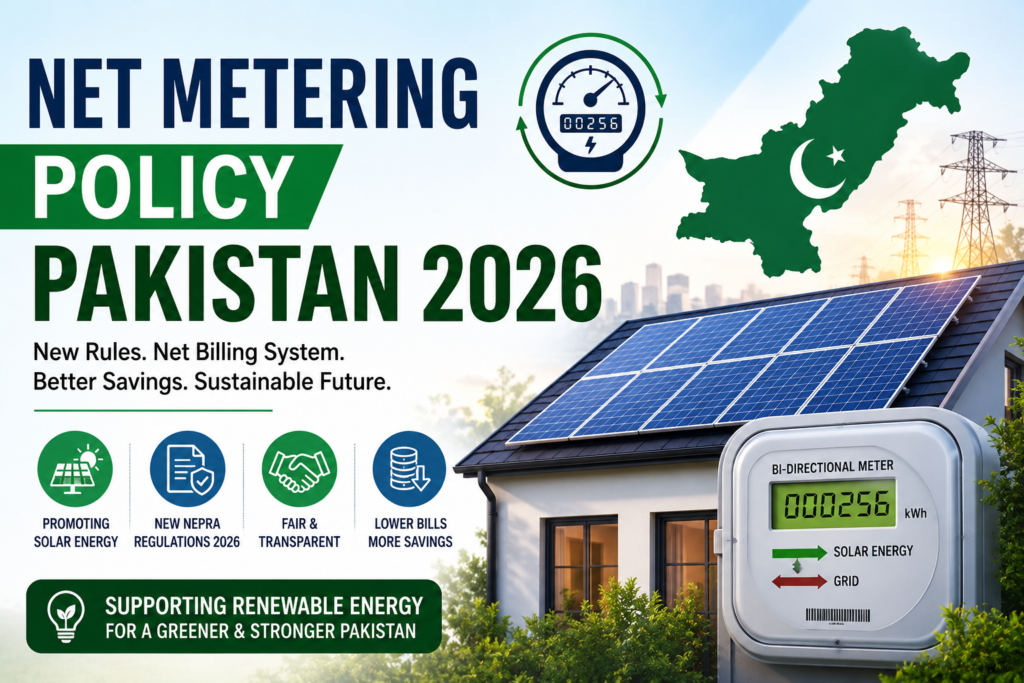
Instead, surplus electricity sent to the grid is purchased at a designated buyback rate linked to the National Average Energy Purchase Price. Consumers continue purchasing electricity from the grid at standard retail tariffs determined by their electricity provider. This creates a noticeable difference between buying and selling electricity. Net Metering Policy Pakistan 2026
End of Unit-for-Unit Adjustment
The elimination of unit-for-unit adjustment marks a fundamental shift in Pakistan’s solar economics. Under the old model, exporting 100 units could offset 100 imported units. Under the new framework, those 100 exported units are compensated financially rather than exchanged directly.
This means solar system owners must pay closer attention to self-consumption. Electricity used directly within the home or business becomes more valuable than electricity exported to the grid because exported power receives a lower compensation rate. Net Metering Policy Pakistan 2026
NEPRA Prosumer Regulations 2026
Key Objectives
NEPRA introduced the Prosumer Regulations 2026 to modernize distributed energy generation and address concerns about financial sustainability within Pakistan’s power sector. Regulators argued that the previous framework created economic imbalances as solar adoption accelerated across the country. Net Metering Policy Pakistan 2026
The updated policy aims to create a more standardized billing structure while balancing the interests of solar users, distribution companies, and other electricity consumers. Policymakers believe this approach will support long-term grid stability and improve transparency in energy transactions. Net Metering Policy Pakistan 2026
Regulatory Framework
The new framework officially replaced the Net Metering Regulations 2015. Under the updated regulations:
| Feature | Old Net Metering | New Net Billing |
|---|---|---|
| Unit Adjustment | 1:1 | Not Available |
| Export Compensation | Retail Credit | Buyback Rate |
| Billing Method | Net Consumption | Separate Import/Export |
| Consumer Benefit | High | Moderate |
| Focus | Grid Export | Self Consumption |
The regulations also define agreement periods, payment mechanisms, and eligibility requirements for solar consumers participating in the program.
Net Metering vs Net Billing
Detailed Comparison
The difference between net metering and net billing may sound technical, but it has real financial consequences. Under net metering, consumers effectively stored excess electricity in the grid and recovered it later at equal value. Under net billing, exported electricity is sold at a lower rate and purchased back at a higher retail rate.
For example, a consumer might buy electricity at retail tariffs exceeding Rs. 40 per unit while receiving around Rs. 11 to Rs. 13 per unit for exported solar electricity. This difference significantly changes return-on-investment calculations for new solar projects.
Financial Impact on Consumers
Consumers who previously relied on exporting large amounts of electricity may experience reduced savings under the new model. The financial advantage now shifts toward maximizing on-site energy usage rather than exporting excess production.
This trend mirrors developments seen in several international markets where self-consumption has become the preferred strategy for residential and commercial solar users.
Buyback Rates Under New Rules
One of the most discussed aspects of the 2026 policy is the buyback rate for exported electricity. Current reports indicate that surplus electricity is compensated at the National Average Energy Purchase Price, generally estimated around Rs. 11 to Rs. 13 per kilowatt-hour depending on regulatory adjustments and market conditions.
For many consumers, this rate is substantially lower than the retail price paid when importing electricity from the grid. As a result, the economics of exporting surplus energy have become less favorable than before. Homeowners now have stronger incentives to use generated solar energy directly or invest in battery storage systems to increase self-consumption.
Existing Solar Users and Their Rights
Protection for Existing Agreements
A major concern following the announcement of the new regulations was whether existing solar users would lose previously approved benefits. NEPRA later clarified that existing approvals, licenses, agreements, and regulatory permissions would remain protected under specific conditions.
Consumers operating under previously approved agreements can generally continue under existing arrangements until their agreements expire. Regulatory amendments introduced in 2026 specifically aimed to preserve contractual rights while providing a transition framework for the future.
This protection offers important reassurance to thousands of solar investors who made significant financial commitments under the earlier regulatory environment.
Impact on New Solar Installations
For new solar adopters, the investment equation has changed but has not disappeared. Solar energy remains a highly attractive option because electricity prices continue to rise while solar equipment costs have become increasingly competitive.
The focus has shifted from maximizing exports to maximizing self-consumption. Smart energy management systems, battery storage, and load optimization strategies can help homeowners extract greater value from their solar installations. New buyers should carefully evaluate their daytime energy usage patterns before selecting system sizes.
Advantages of the New Policy
While the policy has received criticism, supporters highlight several potential advantages. The new framework encourages more responsible energy planning and reduces dependence on large-scale grid exports. It also aligns compensation mechanisms with wholesale energy market realities.
Supporters argue that the policy creates a more balanced financial environment for electricity distribution companies and helps prevent cost shifting between solar and non-solar consumers. From a regulatory perspective, the framework may improve long-term grid management as distributed generation continues expanding across Pakistan.
Challenges and Concerns
Industry stakeholders have expressed concerns regarding reduced investment incentives. Lower export compensation may extend solar payback periods and discourage some potential investors from adopting renewable energy technologies.
Community discussions among solar users frequently highlight concerns about the widening gap between import tariffs and export compensation rates. Many users believe the new structure makes rooftop solar less financially rewarding than under the previous system. Despite these concerns, most experts agree that solar remains economically viable, especially when paired with effective self-consumption strategies.
Solar Investment Outlook in Pakistan
Pakistan continues to possess enormous solar potential due to high solar irradiation levels across much of the country. Rising electricity costs, increasing demand for energy independence, and growing environmental awareness continue to support solar adoption.
Investors are increasingly exploring hybrid solar systems that combine solar panels with battery storage. These systems allow users to store daytime energy and consume it during evening hours, reducing dependence on the grid and minimizing exposure to retail electricity tariffs.
The market is likely to evolve rather than contract. Businesses and households that adapt to the new regulatory environment may still achieve substantial long-term savings.
Best Strategies for Homeowners in 2026
Homeowners considering solar installations in 2026 should focus on several practical strategies:
- Maximize daytime electricity usage.
- Size systems according to actual consumption.
- Consider battery storage solutions.
- Use energy-efficient appliances.
- Monitor production and consumption regularly.
The goal is no longer to export as much electricity as possible. Instead, the objective is to consume the majority of generated electricity within the property itself.
Future of Renewable Energy in Pakistan
Pakistan’s renewable energy future remains promising despite regulatory changes. Solar technology continues becoming more affordable, efficient, and accessible. The country’s energy security goals and environmental commitments make renewable energy expansion a national priority.
The transition from net metering to net billing represents a policy evolution rather than a rejection of solar energy. Future regulatory updates may further refine compensation mechanisms, encourage battery adoption, and support smarter energy management systems. As technology advances, consumers will gain new tools to optimize energy production and consumption.
Conclusion
The Net Metering Policy Pakistan 2026 represents one of the most significant changes in the country’s solar energy landscape. Traditional net metering has been replaced by net billing under NEPRA’s Prosumer Regulations 2026, ending the long-standing unit-for-unit adjustment model. New solar consumers must now operate within a framework where exported electricity receives a separate buyback rate while imported electricity is billed at standard retail tariffs.
Although the financial dynamics have changed, solar energy remains a valuable investment for many Pakistani households and businesses. Success in the new environment depends on maximizing self-consumption, exploring battery storage options, and designing systems that align closely with actual energy needs. Pakistan’s renewable energy journey continues, and solar power remains an important part of the nation’s energy future.
FAQs
1. What is the biggest change in Pakistan’s Net Metering Policy 2026?
The biggest change is the replacement of traditional net metering with net billing, eliminating the one-to-one unit adjustment mechanism.
2. Are existing net metering consumers protected?
Yes. NEPRA has clarified that existing agreements and approvals remain protected under specified conditions until agreement expiry.
3. What is the buyback rate under net billing?
Recent reports indicate that exported electricity is compensated at approximately Rs. 11 to Rs. 13 per unit, subject to regulatory adjustments.
4. Is solar still worth installing in Pakistan in 2026?
Yes. Solar remains financially beneficial, especially when homeowners maximize self-consumption and use battery storage solutions.
5. What is the difference between net metering and net billing?
Net metering allowed unit-for-unit adjustment, while net billing separately calculates imported and exported electricity and compensates exports at a designated buyback rate.