
Net Billing Has Been Enabled: Pakistan’s solar energy landscape is evolving rapidly, and one of the most significant developments is the implementation of Net Billing for solar consumers. Homeowners, businesses, and industrial consumers who are planning to install solar systems can now apply under the new framework. This change marks a major shift from the traditional net metering model that many Pakistanis became familiar with over the past few years.
The introduction of net billing in Pakistan has opened new opportunities for electricity consumers who want to reduce their energy costs and make better use of renewable energy sources. If you have already installed or are planning to install a solar power system, this is the right time to take advantage of the latest net billing facility. With net billing now enabled, eligible consumers can submit their applications and start benefiting from a more efficient electricity management system.
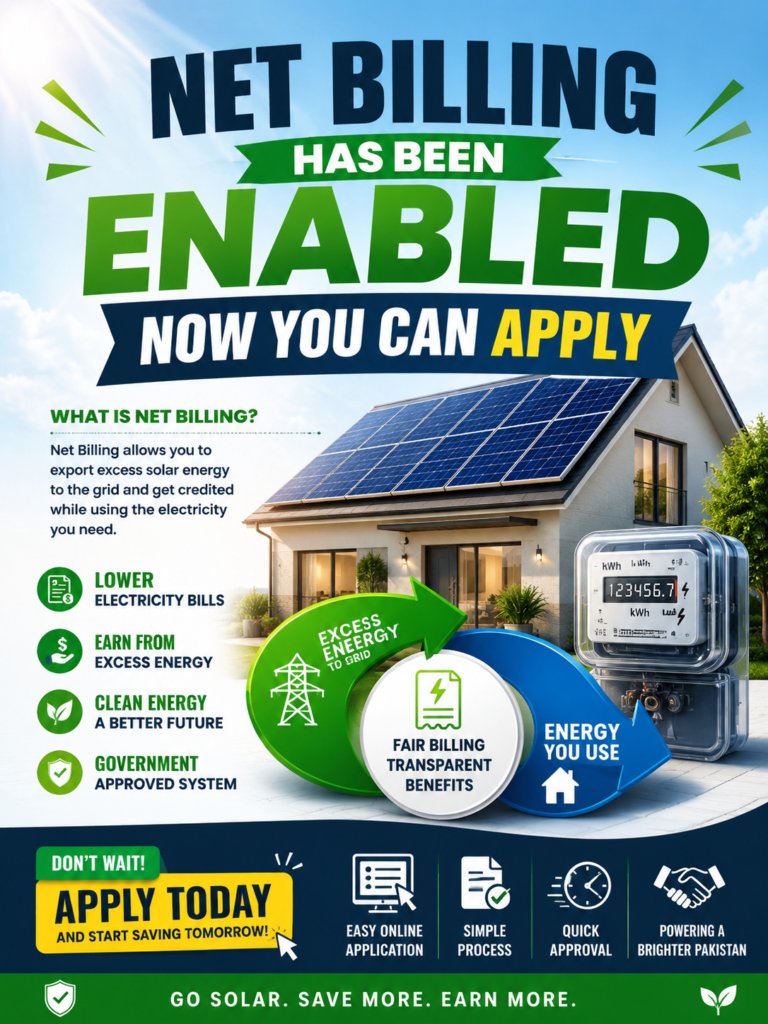
Under the net billing mechanism, consumers can generate electricity through their solar panels and use that energy for their daily needs. Any excess electricity produced can be supplied to the grid according to the applicable regulations and billing policies. This helps maximize the value of a solar investment while encouraging the adoption of clean energy across the country.
The application process is straightforward for most consumers. Applicants typically need a valid electricity connection, the required technical documents, and an approved solar installation that meets the standards set by the relevant authorities. Once the application is reviewed and approved, the consumer can begin participating in the net billing program and enjoy the associated financial benefits.
One of the biggest advantages of net billing is the potential reduction in monthly electricity expenses. As electricity prices continue to rise, many homeowners and businesses are turning to solar energy as a long-term solution. Net billing further improves the return on investment by allowing consumers to make better use of the electricity they generate.
If you have been waiting for the right time to switch to solar energy, the activation of net billing provides an excellent opportunity. Start preparing your documents, verify your system requirements, and submit your application today to take advantage of this energy-saving initiative.
Net Billing Has Been Enabled
The government’s decision aims to modernize the electricity sector while encouraging responsible solar adoption. As electricity prices continue to rise, solar energy remains one of the most attractive investments for households and businesses looking to reduce their dependence on grid power. With net billing now officially enabled, applicants can begin the process through the designated online portal and obtain approval for exporting surplus electricity to the national grid. According to recent reports, electricity distribution companies have shifted consumers toward online registration systems, making the application process more streamlined and transparent.
Understanding the New Net Billing System
What Is Net Billing?
Net billing is a mechanism that allows solar energy users to export excess electricity generated by their solar systems to the grid. Unlike older arrangements, exported electricity is credited separately from the electricity consumed from the grid. This means consumers receive compensation for the energy they supply, while still paying normal tariffs for the electricity they import. Net Billing Has Been Enabled

Think of the electricity grid as a large marketplace. When your solar panels produce more electricity than you need during the day, you effectively sell that surplus energy to the utility company. Later, when your solar system is not generating enough power, such as during the evening, you buy electricity from the grid. Under net billing, these transactions are calculated separately.
This approach provides greater transparency in energy accounting and allows regulators to better manage electricity flows. It also helps power companies balance the increasing number of distributed solar installations connected to the network. Net Billing Has Been Enabled
How Net Billing Differs from Net Metering
Many people confuse net billing with net metering, but there are important differences. Under traditional net metering, exported electricity could offset imported electricity on a near one-to-one basis. Consumers often reduced their bills significantly because units sent to the grid directly balanced units consumed later.
Under the new net billing framework, exported electricity is purchased at a predefined rate, while imported electricity is billed at standard consumer tariffs. Recent regulations indicate that exported electricity may be compensated at approximately Rs. 11 per unit, while imported electricity continues to be charged according to regular electricity tariffs. Net Billing Has Been Enabled
| Feature | Net Metering | Net Billing |
|---|---|---|
| Unit Offset | Direct offset | Separate accounting |
| Export Compensation | Unit-based adjustment | Fixed compensation rate |
| Billing Structure | Net consumption | Import and export billed separately |
| Agreement Period | Previously longer | Typically five years |
Why Pakistan Introduced Net Billing
Government Objectives
The introduction of net billing is part of broader energy sector reforms. Policymakers have expressed concerns about the long-term financial sustainability of the power sector as solar adoption continues to grow. The government seeks to encourage renewable energy while maintaining a balanced electricity market. Net Billing Has Been Enabled
One objective is to ensure that electricity distribution companies can continue recovering infrastructure and operational costs. As more consumers generate their own electricity, traditional utility revenue models become more challenging. Net billing creates a system where solar consumers still contribute fairly to grid maintenance while receiving compensation for surplus generation. Net Billing Has Been Enabled

Impact on the Power Sector
The power sector has experienced significant pressure due to rising solar installations across Pakistan. Thousands of consumers have invested in rooftop solar systems, reducing their reliance on grid electricity. While this trend supports clean energy goals, regulators believe a revised framework is necessary to maintain system stability.
Recent regulatory updates have introduced new guidelines, including revised compensation mechanisms and licensing requirements for certain installations. These changes are intended to create a more structured environment for future solar growth.
Latest Updates on Net Billing Applications
Online Application Process
One of the most important updates for consumers is that applications are now being processed through an online portal. Distribution companies have clarified that applications have not been stopped. Instead, the registration process has been digitized to improve efficiency and transparency. Consumers receive registration numbers and tracking information immediately after submitting their applications online. Net Billing Has Been Enabled

The official portal allows users to submit net billing applications, check application status, and access guidance materials. This digital approach reduces paperwork and minimizes delays associated with manual submissions. Net Billing Has Been Enabled
New Regulatory Framework
Pakistan’s updated regulations have formally shifted new solar consumers toward net billing arrangements. Authorities have also introduced new compliance requirements designed to standardize solar installations across the country. These regulations affect residential, commercial, and industrial users who wish to connect solar systems to the grid.
Eligibility Criteria for Net Billing
Residential Consumers
Homeowners with rooftop solar systems can apply for net billing provided they meet the technical and regulatory requirements established by their local electricity distribution company. Applicants typically need a valid electricity connection, approved solar equipment, and compliance with safety standards.
Residential users stand to benefit significantly from daytime self-consumption. By using solar energy directly during daylight hours, households can reduce their electricity purchases from the grid and lower monthly bills.
Commercial and Industrial Consumers
Businesses often have higher electricity consumption and can benefit even more from solar installations. Commercial buildings, factories, warehouses, and office complexes frequently have large roof areas suitable for solar panels.
Net billing enables these organizations to offset operational costs while supporting sustainability goals. For many businesses, solar energy is becoming an essential component of long-term energy planning.
Documents Required for Application
Identity and Ownership Documents
Applicants generally need:
- CNIC copy
- Recent electricity bill
- Property ownership or authorization documents
- Consumer account details
Providing accurate information is critical because discrepancies can delay approvals.
Solar System Documentation
Consumers must also submit technical information related to their solar installation, including:
- Solar panel specifications
- Inverter details
- System capacity
- Installer information
- Electrical diagrams where required
These documents help authorities verify compliance with safety and technical standards.
Step-by-Step Guide to Apply for Net Billing
Registration Process
Applying for net billing has become easier due to the online portal. The basic process includes:
- Create an account on the official portal.
- Enter consumer and connection details.
- Upload required documents.
- Submit the application.
- Receive a registration number.
- Track application progress online.
The portal is designed to provide immediate confirmation and improve transparency throughout the approval process.
Approval and Inspection
After submission, the application undergoes technical review. Authorities verify documentation and may conduct site inspections to ensure compliance. Once approved, the required metering equipment is installed and activated.
The inspection stage is particularly important because it ensures safe integration of the solar system with the electricity grid.
Benefits of Applying for Net Billing
Lower Electricity Bills
The most obvious benefit is reduced electricity expenses. Solar energy generated during the day can directly power household appliances and business operations. This decreases dependence on expensive grid electricity.
Even though export compensation rates differ from previous net metering arrangements, self-consumption remains highly valuable. The more electricity consumers use directly from their solar systems, the greater their savings.
Better Solar Investment Returns
Solar technology has become more affordable in recent years. Combined with rising electricity tariffs, this has improved the economics of solar installations. Net billing provides an additional revenue stream by compensating consumers for surplus energy supplied to the grid.
Many solar investors view net billing as a way to maximize system utilization while contributing clean energy to the national network.
Challenges and Considerations
Export Rate Changes
Consumers should understand that net billing compensation rates differ from older net metering benefits. Under current regulations, exported electricity is compensated at a lower predefined rate rather than receiving direct unit-for-unit adjustments.
This means system sizing becomes more important than ever. Installing a system that closely matches your consumption pattern often provides better financial results than significantly oversizing the installation.
Licensing Requirements
Recent policy updates have introduced licensing requirements for certain solar installations. Consumers should verify the latest requirements before proceeding with new projects. Compliance with licensing rules helps avoid delays and ensures eligibility for net billing participation.
Future of Solar Energy in Pakistan
Growing Adoption Trends
Despite regulatory changes, Pakistan’s solar market continues to expand. Rising electricity costs, frequent load-shedding concerns, and increasing awareness of renewable energy are driving adoption across the country.
The shift to net billing does not eliminate the value of solar energy. Instead, it changes how consumers calculate returns on investment. Households and businesses that focus on maximizing self-consumption can still achieve substantial savings.
Industry experts expect continued growth in solar installations over the coming years as technology costs decline and energy demand increases. The transition toward cleaner energy sources remains an important national priority, and solar power is likely to play a major role in Pakistan’s energy future.
Conclusion
Net billing has officially opened a new chapter for solar consumers in Pakistan. With online applications now available, homeowners and businesses can apply through the designated portal and begin benefiting from solar energy under the updated framework. While the new system differs from traditional net metering, it still offers meaningful opportunities to reduce electricity costs and improve energy independence.
Consumers who understand the new rules, optimize their solar system size, and maximize self-consumption can continue to enjoy strong long-term value from solar investments. As renewable energy adoption grows, net billing is expected to become a central part of Pakistan’s modern electricity ecosystem.