
10kW Solar System Net Metering Pakistan: Pakistan’s solar industry has exploded over the last few years. Rising electricity tariffs, extended load shedding in some regions, and uncertainty in energy pricing have pushed thousands of homeowners toward solar power. Among all residential options, the 10kW solar system has become one of the most popular choices because it offers a strong balance between cost, power generation, and long-term savings. For many households, it is the point where solar stops being a small bill-reduction tool and becomes a serious investment capable of covering most electricity needs.
10kW Solar System Net Metering Pakistan
A 10kW system generally consists of 16 to 20 high-efficiency solar panels, depending on panel wattage, along with an inverter, mounting structure, safety equipment, and optional batteries. Under Pakistan’s climate conditions, this system can generate enough electricity to power a large home, small office, clinic, or commercial setup. The actual output depends on factors such as location, sunlight hours, panel quality, and installation angle. 10kW Solar System Net Metering Pakistan
One of the biggest reasons people choose this size is the ability to participate in net metering or net billing programs, allowing excess electricity to be sent back to the grid. This helps maximize the value of solar energy rather than wasting surplus power during the daytime.
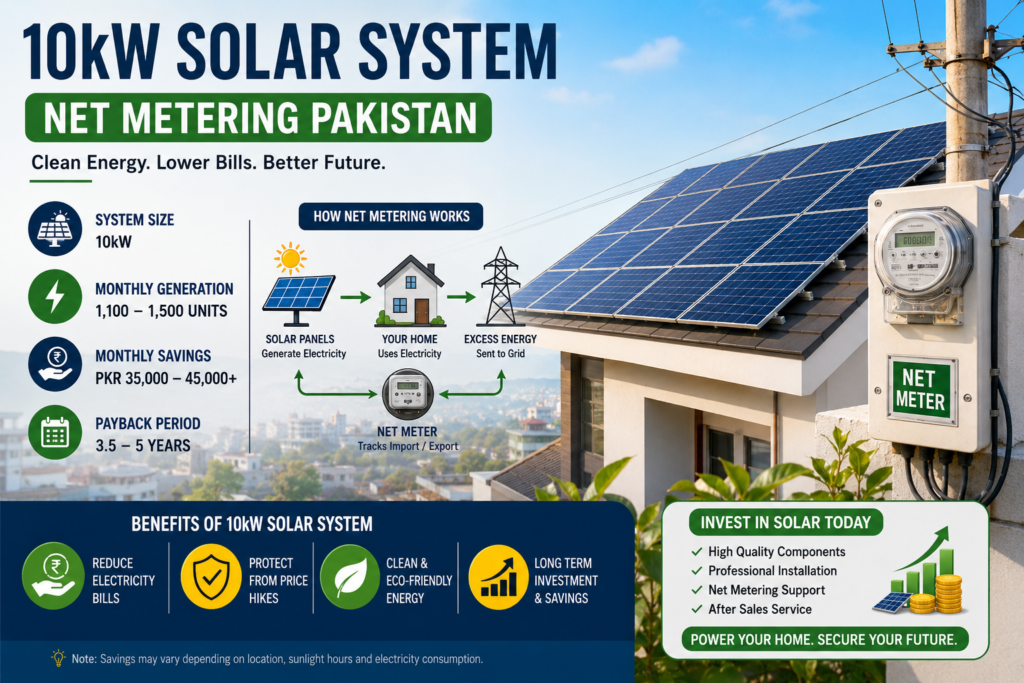
As electricity costs continue to rise, more Pakistani families are viewing solar not as an expense but as a financial asset that pays for itself over time. Recent industry estimates suggest that a properly designed 10kW system can still achieve a payback period of roughly 3.5 to 5 years depending on usage patterns and equipment quality. 10kW Solar System Net Metering Pakistan
What Appliances Can a 10kW Solar System Run?
A common question homeowners ask is whether a 10kW system can handle their daily electricity needs. The answer is yes for most large households. A properly designed setup can run multiple inverter air conditioners, refrigerators, deep freezers, washing machines, water pumps, LED lighting, televisions, laptops, and kitchen appliances simultaneously. 10kW Solar System Net Metering Pakistan
In practical terms, a 10kW system is often suitable for homes with three to five bedrooms and several air conditioners operating during the day. Many Pakistani households consuming between 1,000 and 1,500 units per month find this system size ideal because it offsets a significant portion of their electricity bill. According to current market data, homes with monthly bills ranging from PKR 40,000 to PKR 80,000 often see the greatest benefits from a 10kW installation. 10kW Solar System Net Metering Pakistan
Who Should Install a 10kW Solar Setup?
Not every home requires a 10kW system. Smaller households with low electricity consumption may achieve better returns with a 5kW or 7kW setup. A 10kW system is best suited for larger families, homes with multiple air conditioners, small offices, educational institutions, clinics, and businesses with substantial daytime energy usage.
The key factor is consumption during daylight hours. Since solar panels generate electricity when the sun is shining, households that actively use power during the day gain the highest value. This becomes even more important under Pakistan’s updated net billing framework, where self-consumption provides better financial returns than exporting excess electricity to the grid. Households that run air conditioners, pumps, office equipment, or commercial machinery during daylight hours are typically the biggest winners. 10kW Solar System Net Metering Pakistan
Why 10kW Systems Are Popular in Pakistan
Pakistan’s electricity sector has experienced significant changes over the past decade. Rising fuel costs, infrastructure challenges, and increasing demand have pushed electricity prices upward. As a result, many consumers now see solar energy as one of the few reliable ways to control long-term energy expenses. 10kW Solar System Net Metering Pakistan
The popularity of 10kW systems stems from their ability to cover a substantial portion of household consumption without becoming excessively expensive. Smaller systems reduce bills, but larger systems create a greater level of energy independence. This middle-ground position makes the 10kW category particularly attractive.
Another major factor is the availability of improved solar technology. Modern Tier-1 solar panels from manufacturers such as LONGi, Jinko, JA Solar, and Canadian Solar deliver significantly higher efficiency compared to earlier generations. Combined with advanced inverters from brands like Huawei, Growatt, Solis, and GoodWe, today’s systems generate more power from the same roof space. This technological improvement has helped drive solar adoption across cities such as Lahore, Islamabad, Karachi, Multan, Faisalabad, and Peshawar. 10kW Solar System Net Metering Pakistan
Rising Electricity Prices
Electricity bills have become one of the largest monthly expenses for many Pakistani households. Consumers often experience escalating tariffs, fuel adjustment charges, taxes, and seasonal variations that make budgeting difficult. Solar power offers predictability. Once installed, the sunlight falling on your roof remains free.
For families paying tens of thousands of rupees every month, the math becomes increasingly attractive. Instead of continually paying higher utility bills, homeowners redirect that money into an asset that generates savings for decades. Solar panels commonly carry performance warranties of up to 25 years, making them one of the longest-lasting investments available for residential properties.
Increased Demand for Energy Independence
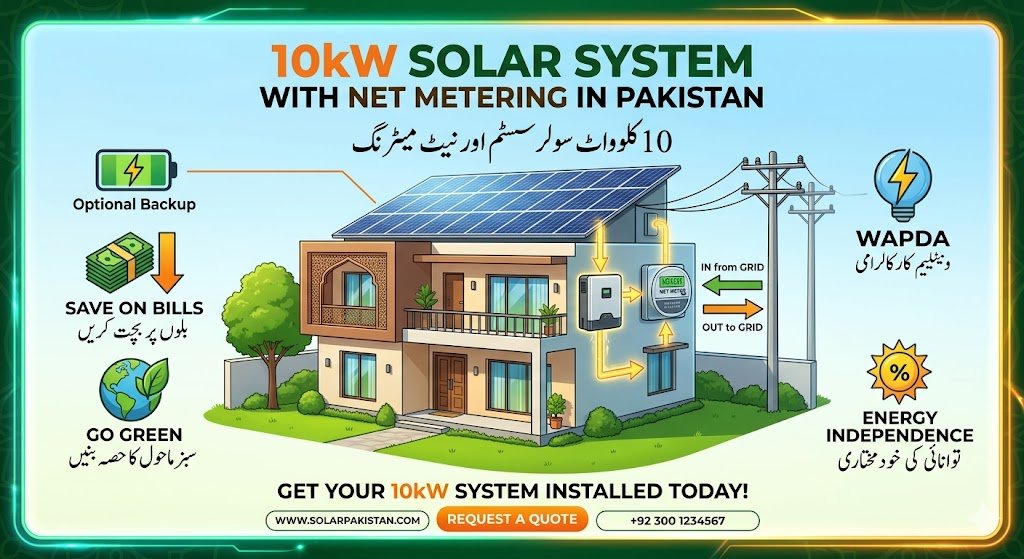
Many homeowners are no longer interested in relying entirely on the national grid. They want stability, lower costs, and protection from future price increases. A 10kW solar system provides exactly that. Even under newer net billing rules, daytime energy consumption can be significantly reduced because the home uses solar-generated electricity directly. 10kW Solar System Net Metering Pakistan
This shift toward energy independence is one reason why Pakistan’s cumulative solar capacity has continued growing despite regulatory changes. Industry reports indicate that Pakistan surpassed 6 GW of cumulative net-metered solar capacity, reflecting the strong demand for rooftop solar solutions nationwide. 10kW Solar System Net Metering Pakistan
Latest Net Metering Rules in Pakistan 2026
The biggest topic in Pakistan’s solar market during 2026 has been the transition from traditional net metering toward newer net billing regulations. Understanding these changes is essential before investing in a 10kW solar system. 10kW Solar System Net Metering Pakistan
Under the older net metering framework, exported electricity could effectively offset imported electricity on a nearly one-to-one basis. This allowed some consumers to reduce their bills dramatically or even generate credits. The new framework has changed how exported electricity is valued, creating a different financial equation for solar users.
Difference Between Net Metering and Net Billing
Traditional net metering functioned like a storage bank. During the day, excess electricity flowed into the grid. At night, homeowners could effectively withdraw electricity against those credits. This arrangement encouraged oversized systems because exported energy retained substantial value.
Net billing works differently. Electricity exported to the grid is purchased at a lower wholesale rate, while imported electricity is charged at retail rates. Current estimates suggest export compensation may range around PKR 11 to 13 per unit under newer regulations, while retail consumption can exceed PKR 40 per unit. This difference places greater importance on consuming solar energy directly rather than exporting large amounts.
New NEPRA Regulations Explained
Recent NEPRA regulations have introduced several changes affecting new solar adopters. Industry reports indicate shorter agreement structures, revised compensation rates, and additional compliance requirements for approved installations. Some reports also mention licensing requirements for certain system categories and stricter grid connection procedures.
For homeowners considering a 10kW installation, the practical takeaway is simple: design the system around your daytime electricity consumption rather than maximizing exports. Systems that closely match household usage patterns continue to deliver strong returns despite policy changes.
10kW Solar System Components
A high-quality solar installation is much more than just panels on a roof. Each component plays a crucial role in performance, safety, and reliability.
Solar Panels
Modern 10kW systems typically use 550W to 615W monocrystalline solar panels. Depending on the exact wattage, homeowners usually require 16 to 19 panels to achieve the desired capacity. Tier-1 manufacturers remain the preferred choice because they offer higher efficiency, stronger warranties, and better long-term performance.
Inverter Selection
The inverter is often described as the brain of the solar system. It converts DC electricity generated by the panels into usable AC electricity for household appliances. Popular inverter brands in Pakistan include Huawei, Solis, Growatt, GoodWe, and SMA. Buyers can choose between on-grid, hybrid, and off-grid models depending on their objectives.
Mounting Structure and Protection Equipment
Proper mounting structures are critical for Pakistan’s weather conditions. Galvanized steel or aluminum structures help protect against corrosion and wind damage. Safety equipment such as surge protection devices, isolators, circuit breakers, and earthing systems are increasingly important under modern regulatory requirements.
10kW Solar System Price in Pakistan
One of the most searched questions in Pakistan today is the cost of a 10kW solar system. Prices vary based on component quality, installer reputation, roof complexity, and whether batteries are included.
Complete Cost Breakdown
| Component | Estimated Price Range (PKR) |
|---|---|
| Solar Panels | 470,000 – 620,000 |
| Inverter | 240,000 – 560,000 |
| Mounting Structure | 70,000 – 110,000 |
| Wiring & Protection | 55,000 – 90,000 |
| Installation | 55,000 – 95,000 |
| Total On-Grid System | 850,000 – 1,750,000 |
Current market estimates place complete 10kW installations between approximately PKR 850,000 and PKR 1.75 million depending on equipment quality and installer selection. Premium systems with advanced inverters and imported components naturally cost more.
Additional Net Metering Charges
Homeowners should also budget for regulatory expenses associated with net metering or net billing approval. These may include documentation, application processing, bidirectional meter installation, inspections, and compliance requirements.
Industry sources estimate these additional expenses can range from PKR 100,000 to PKR 250,000 depending on location and utility provider. Hidden costs such as three-phase upgrades and structural modifications may also arise during installation.
Monthly Electricity Generation and Savings
A 10kW system in Pakistan can typically generate between 1,100 and 1,500 units of electricity per month depending on weather conditions, panel orientation, and geographical location. Southern regions generally receive stronger solar irradiance and therefore achieve slightly higher production.
Expected Unit Production
The average annual production often falls between 14,000 and 18,000 units. Seasonal fluctuations are normal. Summer months produce more electricity due to longer daylight hours, while winter generation is slightly lower.
Monthly Financial Benefits
The exact savings depend on consumption habits. Homes that use most of their electricity during the day benefit the most. According to current industry estimates, a 10kW system may save approximately PKR 420,000 to PKR 520,000 annually under favorable usage patterns. This translates into a potential payback period of roughly 3.5 to 5 years.
Net Metering Application Process
Applying for net metering involves several steps. Although procedures vary slightly between DISCOs, the overall process remains similar across Pakistan.
Required Documents
Applicants typically need:
- Copy of CNIC
- Recent electricity bill
- Property ownership documentation
- Solar installation details
- Single-line electrical diagram
- Installer certifications
Working with an experienced solar company can simplify the process considerably because most paperwork is handled on behalf of the customer.
Approval Timeline
Approval timelines vary by utility company and region. Some applications are processed within a few weeks, while others may take several months depending on inspection schedules and grid capacity limitations. Certain areas have experienced delays due to growing demand and transformer capacity constraints.
On-Grid vs Hybrid Solar System
One of the most important decisions in 2026 is choosing between an on-grid and hybrid system.
Which Option Is Better in 2026?
Under older net metering policies, on-grid systems were often the obvious choice because exported electricity carried significant value. With newer net billing regulations, many experts now recommend hybrid systems that incorporate battery compatibility.
A hybrid inverter allows homeowners to store excess daytime generation for nighttime use rather than exporting it at lower rates. While batteries increase upfront costs, they can improve self-consumption and reduce dependence on grid electricity. This strategy aligns closely with the realities of Pakistan’s current solar market. Multiple industry experts and community discussions increasingly support hybrid-ready systems for future flexibility.
Challenges and Mistakes to Avoid
The biggest mistake buyers make is focusing solely on the cheapest quotation. Low-quality components may save money initially but often create performance issues later. Poor installation practices can reduce output, increase maintenance requirements, and even create safety hazards.
Another common mistake is oversizing the system. Under current regulations, exporting excessive electricity is less financially attractive than it once was. Homeowners should carefully analyze their consumption patterns before selecting a system size.
Ignoring roof condition is another costly error. Solar panels remain in place for decades. Any structural problems should be addressed before installation begins. Finally, always verify installer credentials, warranty coverage, and after-sales support. A reputable installer often provides more long-term value than a lower-priced competitor.
Conclusion
A 10kW solar system in Pakistan remains one of the most practical investments for households and businesses facing high electricity bills. Although net metering policies have evolved into newer net billing structures, solar energy continues to offer substantial savings when systems are properly sized and designed around self-consumption.
Current installation costs typically range from under one million rupees for budget setups to well over 1.5 million rupees for premium systems. Despite regulatory changes, many homeowners can still recover their investment within a few years while gaining greater protection from rising electricity prices. The smartest approach in 2026 is no longer maximizing exports to the grid. Instead, success comes from maximizing the amount of solar energy you use directly inside your home or business.
FAQs
1. How many units does a 10kW solar system produce per day in Pakistan?
A 10kW solar system typically produces around 35 to 50 units per day depending on weather conditions, location, and panel efficiency.
2. What is the price of a 10kW solar system in Pakistan in 2026?
Most complete systems cost between PKR 850,000 and PKR 1.75 million, depending on equipment quality and installation requirements.
3. Is net metering still available in Pakistan?
Pakistan has introduced newer net billing regulations that differ from the traditional net metering model. Exported electricity is compensated at lower rates than imported electricity.
4. Is a hybrid solar system better than an on-grid system?
For many homeowners in 2026, hybrid systems offer greater flexibility because excess electricity can be stored in batteries instead of being exported at lower buyback rates.
5. How long does it take to recover the investment?
Most 10kW systems achieve payback within approximately 3.5 to 5 years depending on electricity usage, solar production, and equipment selection.