
AC Ka Bill Kam Kaise Karein: Summer in Pakistan feels hotter every year, especially in cities like Multan, Lahore, and Karachi where temperatures can become unbearable. Because of this, air conditioners are no longer a luxury for many families. They have become a necessity. The real problem starts when the electricity bill arrives. One AC running for a few hours daily can push monthly expenses much higher than expected. Many people think the only solution is to stop using the AC completely, but that is not practical in extreme heat.
AC Ka Bill Kam Kaise Karein
The good news is that you can reduce your AC electricity bill significantly without sacrificing comfort. Small changes in daily habits, proper AC settings, and smarter cooling methods can save thousands of rupees every month. Most households waste electricity unknowingly. They run the AC at the wrong temperature, ignore maintenance, or use old cooling habits that consume extra power. Think of your AC like a car. If you drive aggressively, ignore servicing, and waste fuel, the cost naturally increases. The same principle applies to air conditioners.
Electricity tariffs in Pakistan have also increased sharply in recent years. According to recent reports, residential consumers in higher slabs can pay around Rs. 47 per unit or even more after taxes and adjustments. This makes energy efficiency more important than ever. In this detailed guide, you will learn practical and realistic ways to lower your AC bill while still keeping your home cool during the hottest months. AC Ka Bill Kam Kaise Karein
Why AC Bills Become So High in Pakistan
One major reason AC bills become expensive in Pakistan is the rising electricity tariff structure. Electricity rates are calculated in slabs, meaning the more units you consume, the more expensive each unit becomes. A household that crosses 700 units can face rates above Rs. 47 per unit before taxes and fuel adjustments are added. Once an AC starts running daily, total monthly units increase very quickly. Many people underestimate how much power an air conditioner can actually consume. AC Ka Bill Kam Kaise Karein
A 1.5-ton inverter AC can consume roughly 400W to 1800W depending on usage conditions, while a non-inverter model may continuously run near full power. If the AC runs for 8 to 10 hours daily, the monthly consumption rises dramatically. Add refrigerators, fans, irons, and washing machines into the mix, and suddenly the household moves into a higher electricity slab. That is why bills jump unexpectedly during summer. AC Ka Bill Kam Kaise Karein
Another reason is poor usage habits. Many people set the AC temperature to 16°C thinking it cools faster. In reality, the AC compressor keeps working harder for longer periods. Some households also turn the AC on and off repeatedly, which increases compressor stress and power consumption. Rooms with direct sunlight, poor insulation, open doors, or dirty filters also force the AC to work overtime. AC Ka Bill Kam Kaise Karein
Pakistan’s climate also plays a role. In extremely hot regions, the outdoor temperature stays high even at night. This means the AC compressor rarely gets enough rest. When outdoor temperatures cross 45°C, cooling systems consume more electricity simply to maintain indoor comfort. Combined with high tariffs and inefficient habits, electricity bills can become difficult for middle-class families to manage. AC Ka Bill Kam Kaise Karein
Understanding How Much Electricity an AC Uses
Before reducing your AC bill, it helps to understand how electricity consumption actually works. Many people hear terms like “units,” “watts,” or “inverter technology” but never fully understand them. Electricity usage is measured in kilowatt-hours, commonly called units in Pakistan. If an appliance consumes 1000 watts for one hour, it uses one electricity unit. AC Ka Bill Kam Kaise Karein
A standard non-inverter AC works like a switch. It runs at full power until the room cools down and then shuts off completely. Once the room warms again, it restarts at maximum power. This repeated start-stop cycle consumes a lot of electricity. In contrast, an inverter AC adjusts compressor speed gradually. After cooling the room, it slows down and maintains temperature efficiently. AC Ka Bill Kam Kaise Karein
Here is a simple comparison:
| AC Type | Approximate Power Usage | Monthly Cost Potential |
|---|---|---|
| 1 Ton Inverter AC | 300W – 1300W | Lower |
| 1.5 Ton Inverter AC | 400W – 1800W | Moderate |
| 1.5 Ton Non-Inverter AC | Around 1800W Constant | Higher |
| 2 Ton AC | 1800W – 2600W | Very High |
This explains why inverter ACs are strongly recommended in Pakistan today. Community discussions online also show that most users experience noticeably lower electricity usage with inverter models compared to traditional non-inverter systems. Even though inverter ACs cost more initially, they often recover the extra price through lower electricity bills over time. AC Ka Bill Kam Kaise Karein
Room size matters too. Installing a 2-ton AC in a small room wastes electricity unnecessarily. On the other hand, installing a small AC in a very large room forces the compressor to work constantly. Choosing the correct tonnage is extremely important for efficient cooling and lower monthly bills.
Best Temperature Setting to Save Electricity
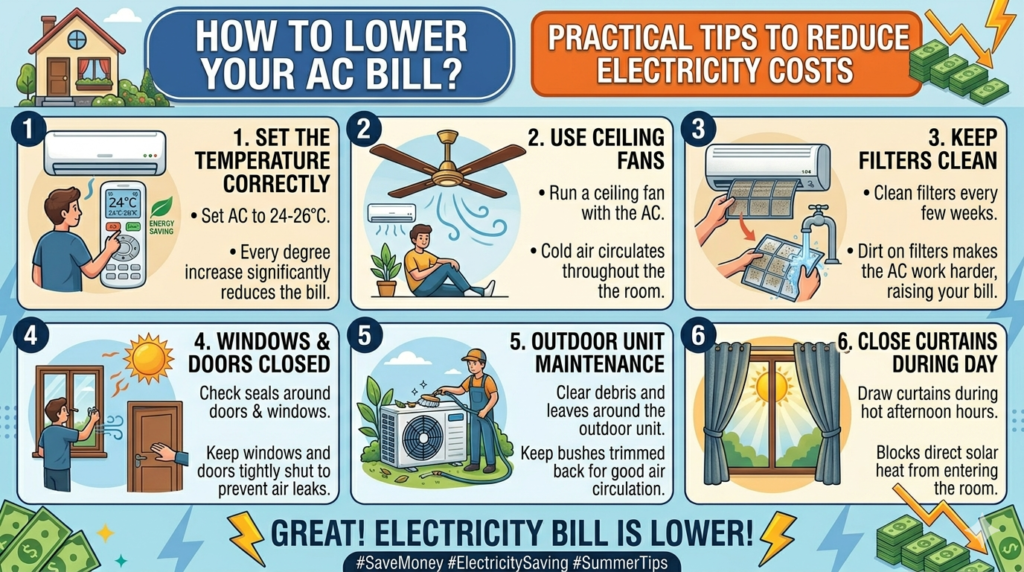
One of the easiest and most effective ways to reduce your AC bill is adjusting the temperature correctly. Surprisingly, many people use their AC inefficiently simply because they misunderstand how cooling works. Setting the AC to 16°C does not cool the room instantly. It only forces the compressor to keep running longer, increasing electricity usage.
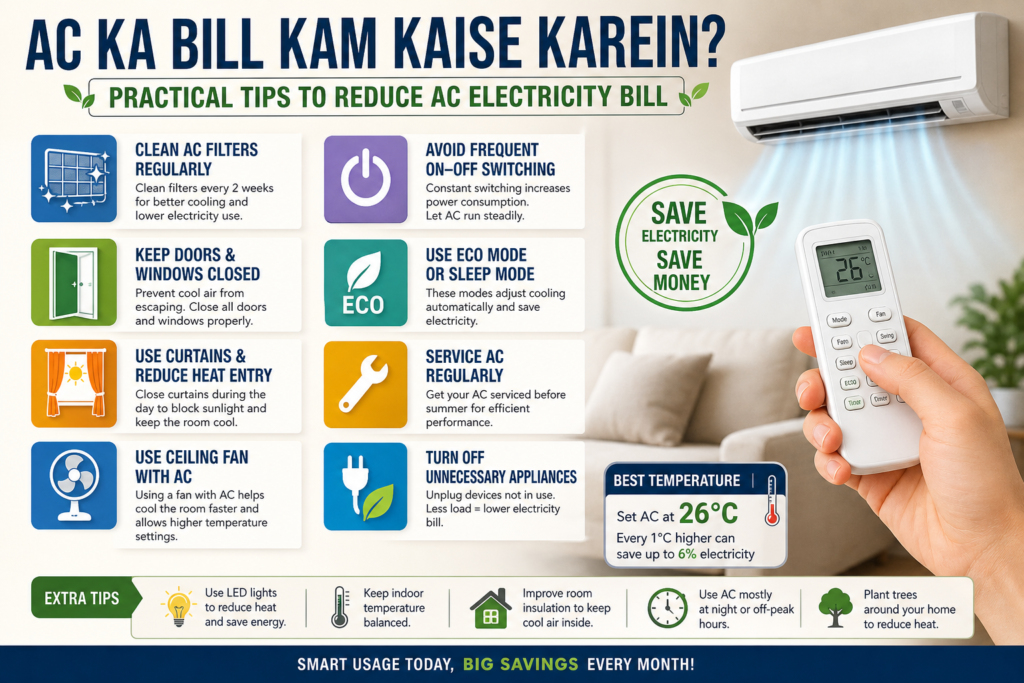
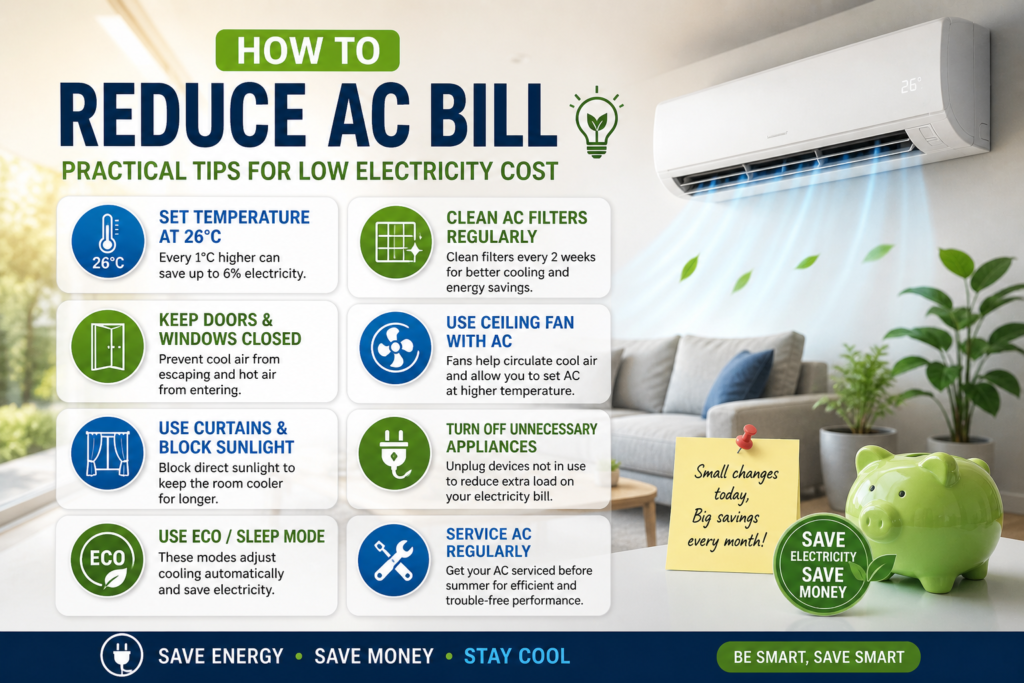
Energy experts and AC manufacturers commonly recommend keeping the temperature around 26°C for balanced comfort and efficiency. Reports suggest that every degree higher can save around 6% electricity. That means using 26°C instead of 20°C could make a noticeable difference in your monthly bill.
Think about it this way. Your AC is not trying to create winter weather inside your bedroom. It only needs to make the room comfortable enough to sleep or relax. Pairing the AC with a ceiling fan improves air circulation and helps the room feel cooler without lowering the temperature excessively. Many people in Pakistan now use this combination successfully to reduce energy costs. AC Ka Bill Kam Kaise Karein
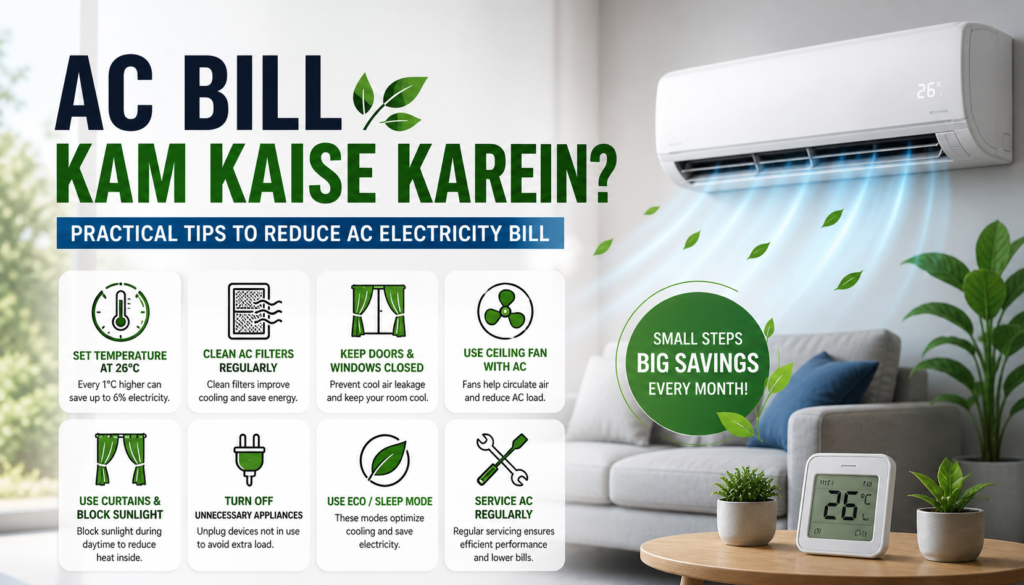
Another helpful tip is using sleep mode at night. During sleep, the body naturally requires less cooling. Sleep mode gradually increases the temperature slightly over several hours, reducing compressor workload. Eco mode also limits maximum power usage while still maintaining cooling.
Avoid changing temperatures repeatedly. Constantly adjusting settings forces the compressor to work harder. Instead, set a comfortable temperature once and let the AC maintain it steadily. This simple habit can improve efficiency more than most people realize.
Practical Tips to Reduce AC Bill
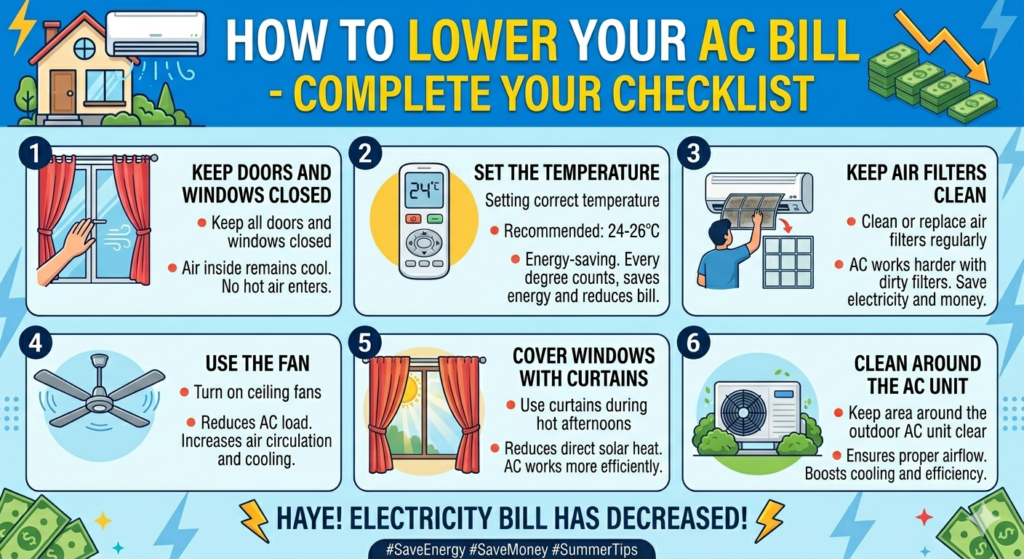
Reducing your AC bill is not about one magical trick. It is usually the combination of several small improvements that creates real savings. One of the most overlooked areas is maintenance. Dirty filters block airflow and make the AC work much harder than necessary. Cleaning filters every two weeks during summer improves cooling efficiency and reduces electricity consumption.
Another major factor is room sealing. If cool air keeps escaping through open doors, window gaps, or damaged curtains, your AC continuously struggles to maintain temperature. Even a small air leak can increase compressor runtime. Properly closing doors and windows keeps cool air trapped inside the room.
Sunlight also affects cooling performance. Rooms exposed to direct afternoon sunlight become much hotter. Thick curtains, blinds, or reflective window films can dramatically reduce indoor heat. Some households in Pakistan also install roof insulation or white roof coatings to reflect sunlight and reduce indoor temperatures naturally.
Here are a few practical habits that genuinely help:
- Clean AC filters regularly
- Keep doors and windows closed
- Use curtains during daytime
- Avoid opening the room repeatedly
- Turn off unused lights and appliances
- Use Eco or Sleep Mode
- Service the AC before summer starts
- Keep outdoor unit clean and ventilated
Frequent on-off switching is another mistake people make. Every time the compressor restarts, it consumes extra electricity. It is usually more efficient to maintain a steady room temperature rather than constantly shutting the system down and restarting it.
Using unnecessary heat-producing appliances inside the room also increases AC workload. Ironing clothes, cooking, or using powerful electronics inside a closed room creates extra heat. Your AC then has to remove all that additional heat, which increases energy consumption.
Smart Habits That Save Electricity Daily
Most people focus only on the AC itself, but overall household habits matter just as much. Simple lifestyle adjustments can reduce indoor heat and lower AC usage naturally. For example, switching to LED lights helps because traditional bulbs generate more heat. Running heavy appliances during cooler evening hours also reduces indoor temperature buildup.
Ventilation matters too. Early morning and late evening are usually cooler in many Pakistani cities. Opening windows during these hours allows fresh air circulation and reduces trapped indoor heat. Once daytime temperatures rise, closing windows and curtains helps maintain cooler indoor conditions.
Hydration and clothing choices also affect perceived comfort. Lightweight cotton clothes and proper hydration make moderate room temperatures feel much more comfortable. Many families overcool rooms simply because they are trying to create an artificial winter environment indoors.
If multiple family members sleep in one room, cooling efficiency improves because a single AC cools a shared space instead of multiple rooms separately. This approach can save a considerable amount of electricity over an entire summer season.
Regular servicing is equally important. Low gas pressure, dirty coils, or weak airflow can quietly increase power consumption for months. Many ACs consume more electricity not because they are old, but because they are poorly maintained. Spending a little on annual servicing can prevent much larger electricity expenses later.
Is Solar a Good Option for Running ACs in Pakistan?
Solar energy has become extremely popular in Pakistan, especially for households running multiple ACs daily. Rising electricity prices have pushed many homeowners toward solar systems as a long-term solution. Discussions in solar communities frequently show that AC usage is one of the main reasons people install solar panels today.
A 1.5-ton inverter AC can typically require around 1200W to 1800W depending on weather conditions and room insulation. Running several ACs together significantly increases total electricity demand. Solar systems help offset this daytime usage and reduce dependency on expensive grid electricity.
Here is a rough estimate:
| Appliance | Approximate Solar Requirement |
|---|---|
| 1 Ton Inverter AC | 3kW Solar Support |
| 1.5 Ton Inverter AC | 4kW to 5kW |
| 2 ACs + Household Load | 8kW to 10kW |
These are approximate numbers and vary depending on sunlight, battery usage, and appliance efficiency. In hot cities like Multan and Bahawalpur, solar systems perform well because sunlight availability remains high for most of the year.
Hybrid solar systems are becoming more common because they allow daytime solar usage while still supporting nighttime grid power or batteries. Although solar installation costs are still significant, many families see it as protection against continuously rising electricity bills.
That said, solar is not the only solution. Even without solar panels, efficient AC usage habits can still reduce monthly bills substantially. Combining efficient appliances with smart cooling practices often gives the best overall results.
Comparing AC Usage Costs in Pakistan
Understanding estimated operating costs helps households make smarter decisions before buying an AC. Many people focus only on purchase price and ignore long-term electricity expenses. A cheaper non-inverter AC may initially look attractive, but monthly bills can become painful over time.
According to recent estimates, a 1.5-ton inverter AC running around 8 hours daily may cost approximately Rs. 12,000 to Rs. 15,000 monthly depending on electricity rates and usage conditions. Non-inverter models can consume significantly more electricity because they continuously operate near maximum power.
Here is a simplified comparison:
| AC Type | Estimated Monthly Cost |
|---|---|
| 1 Ton Inverter AC | Rs. 8,000 – 10,000 |
| 1.5 Ton Inverter AC | Rs. 12,000 – 15,000 |
| 2 Ton Inverter AC | Rs. 18,000 – 24,000 |
| Non-Inverter AC | Usually Higher |
These figures can increase further depending on electricity slabs, taxes, fuel adjustments, and household consumption levels. That is why energy-efficient cooling habits matter so much in Pakistan today.
Online discussions from AC users consistently show that inverter ACs combined with reasonable temperature settings provide the best balance between comfort and electricity savings. The biggest savings usually come not from one expensive gadget, but from combining good habits with efficient technology.
Best Time to Buy an Energy Efficient AC
Timing also matters when buying a new AC. Prices usually rise sharply during peak summer months because demand increases across Pakistan. Buying during winter or early spring often gives better discounts and installation deals.
When purchasing an AC, focus on efficiency ratings rather than just brand popularity. A properly sized inverter AC with Eco Mode, T3 compressor support, and good warranty coverage is usually a smarter investment for Pakistani weather conditions.
Many users also recommend checking after-sales service quality before buying. A powerful AC becomes useless if spare parts or technicians are unavailable locally. Energy savings depend heavily on long-term maintenance and proper functioning.
If your current AC is extremely old, upgrading to a modern inverter model can noticeably reduce electricity consumption. Although the upfront investment may feel high, lower monthly bills can eventually balance the cost.
Conclusion
Reducing your AC electricity bill in Pakistan is absolutely possible without sacrificing comfort. The key is using your AC intelligently instead of aggressively. Simple habits like setting the temperature to 26°C, cleaning filters regularly, sealing the room properly, and using ceiling fans can create major savings over time.
Electricity prices in Pakistan are unlikely to become cheaper anytime soon, which means efficient energy usage is now more important than ever. Inverter ACs, Eco Mode, proper room insulation, and solar systems are all helpful tools, but your daily habits ultimately make the biggest difference.
Think of electricity savings like fitness. One day of dieting changes nothing, but consistent small improvements create huge long-term results. The same applies to AC usage. A few smart adjustments today can save thousands of rupees every summer while keeping your home cool and comfortable.