
Net Metering vs Net Billing Pakistan: Pakistan’s energy landscape has changed dramatically over the last few years. Rising electricity tariffs, long power outages in some areas, and increasing awareness about renewable energy have pushed thousands of households and businesses toward solar power. Walk through almost any major city today, whether it is Lahore, Karachi, Islamabad, Multan, or Faisalabad, and you will notice solar panels covering rooftops like a second layer of protection against expensive electricity bills.
Net Metering vs Net Billing Pakistan
The biggest attraction of solar energy was not only generating electricity for personal use but also the ability to send excess electricity back to the grid through net metering. This system helped consumers reduce their bills significantly and, in some cases, nearly eliminate them altogether. Solar installations surged as more people realized they could recover their investment quickly while gaining some independence from the national grid.
Things began changing when policymakers raised concerns about the financial impact of rapid solar adoption on electricity distribution companies and non-solar consumers. As a result, Pakistan introduced major reforms through updated NEPRA regulations, shifting the country from traditional net metering toward a new net billing framework. This transition has sparked intense debate among homeowners, businesses, solar companies, and energy experts across the country. Net Metering vs Net Billing Pakistan
What Is Net Metering?
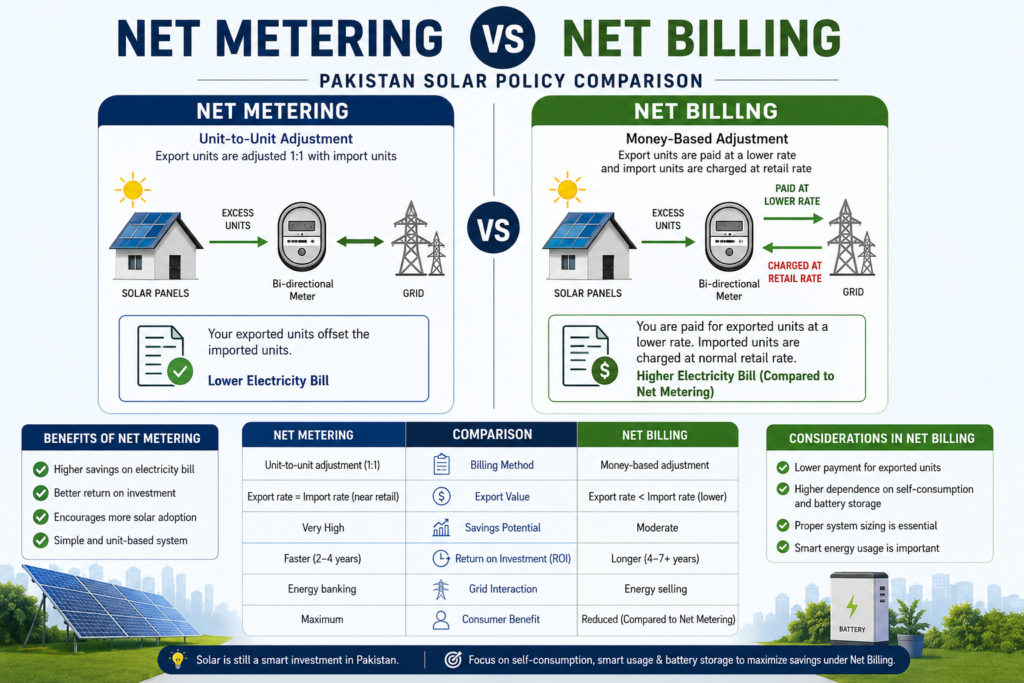
Net metering is a billing mechanism that allows solar users to export excess electricity to the national grid and receive credits in return. Think of the electricity grid as a giant energy bank. During sunny hours, your solar system may produce more electricity than your home consumes. Instead of wasting that energy, it gets sent to the grid.
When nighttime arrives or when solar production drops, you can draw electricity back from the grid. Under the traditional net metering system, exported units and imported units were adjusted against each other on a near one-to-one basis. This arrangement made solar installations extremely attractive because every extra unit exported could offset a unit consumed later. Net Metering vs Net Billing Pakistan
For many Pakistani households, this system felt like having a savings account that worked in electricity units instead of money. The more surplus electricity you generated, the lower your future electricity costs became. This simple concept drove massive solar adoption throughout the country and became one of the most successful renewable energy policies introduced in Pakistan. Net Metering vs Net Billing Pakistan
How Net Metering Worked in Pakistan
Under Pakistan’s earlier framework, consumers with approved solar systems received a bi-directional meter, often called a green meter. This device measured electricity flowing both into and out of the property. If a household exported 500 units during the day and later consumed 500 units from the grid, those units effectively canceled each other out. Net Metering vs Net Billing Pakistan
The beauty of this arrangement was its simplicity. Consumers did not need complicated calculations or financial modeling to understand their savings. Every exported unit held almost the same value as an imported unit. This allowed homeowners to design solar systems capable of generating significant surplus electricity during daylight hours. Net Metering vs Net Billing Pakistan
Many users reported electricity bills dropping by 70% to 100% depending on system size and consumption patterns. Businesses also benefited because lower electricity expenses improved profitability and reduced operational costs. These advantages helped Pakistan rapidly expand rooftop solar installations across residential, commercial, and industrial sectors.
Benefits of the Old Net Metering System
The popularity of net metering was driven by several powerful advantages. First, consumers enjoyed faster return on investment. Many solar installations recovered their costs within two to four years due to substantial bill reductions. This made solar energy one of the most attractive financial investments available to homeowners. Net Metering vs Net Billing Pakistan
Second, the system encouraged clean energy adoption. Every rooftop solar installation reduced dependence on fossil fuels and contributed to lower carbon emissions. Third, consumers gained protection from continuously rising electricity tariffs. While electricity prices increased, solar owners experienced much smaller financial impacts.
Another important advantage was predictability. Solar investors could calculate future savings with reasonable accuracy because exported units held substantial value. This confidence encouraged families and businesses to invest significant amounts into solar infrastructure without worrying about sudden changes in financial returns.
What Is Net Billing?
Net billing is a different approach to compensating solar users for surplus electricity. Instead of adjusting electricity units against each other, the system treats exported electricity as a separate sale transaction. Consumers sell surplus electricity to the grid at one rate and purchase electricity from the grid at another rate. Net Metering vs Net Billing Pakistan
This difference might sound small at first, but it fundamentally changes the economics of solar power. Under net billing, electricity exported during the day is credited at a lower buyback rate determined by regulators. Later, when consumers purchase electricity from the grid, they pay the normal retail tariff, which is significantly higher.
Imagine selling wheat to a market for Rs 11 per kilogram and then buying the same wheat back for Rs 50 per kilogram. That example captures the essence of why many solar users are concerned about the transition. While solar power remains valuable, the financial benefits of exporting electricity have decreased substantially under the new framework. Net Metering vs Net Billing Pakistan
How Net Billing Works
The net billing model separates import and export transactions completely. Electricity generated and consumed instantly within the home provides direct savings because those units never interact with the grid. The challenge arises when surplus electricity is exported. Net Metering vs Net Billing Pakistan
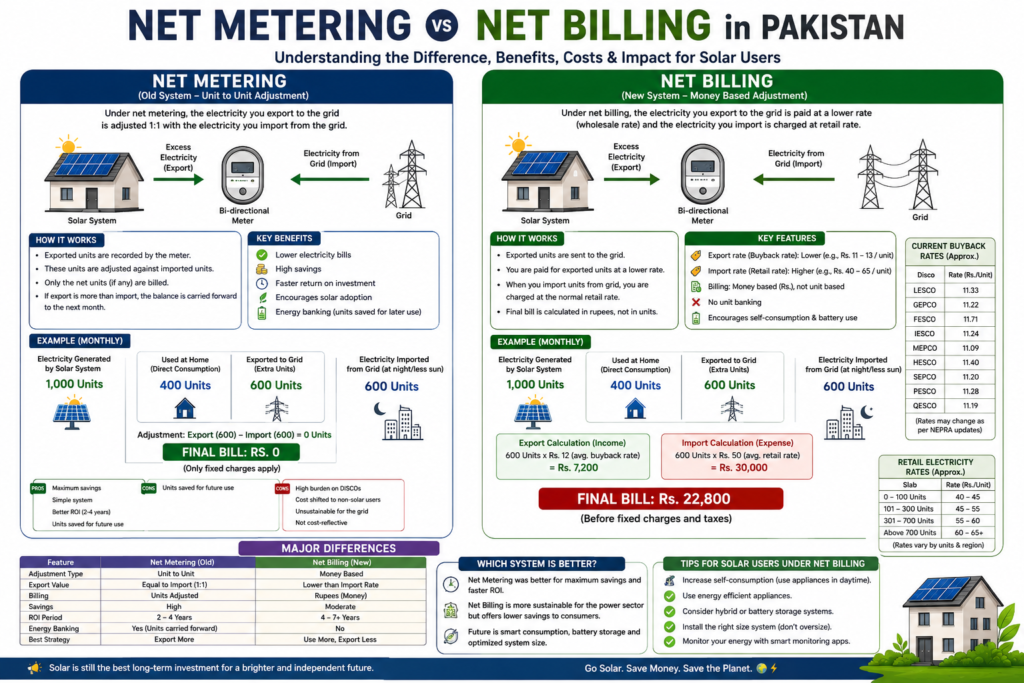
Current discussions and regulations indicate exported electricity may be credited around Rs 11 to Rs 13 per unit, while imported electricity often costs between Rs 40 and Rs 65 per unit depending on tariffs and usage slabs. This means consumers receive much less compensation for exported electricity than they pay when purchasing electricity later. Net Metering vs Net Billing Pakistan
Why Pakistan Shifted Toward Net Billing
Government agencies and regulators argue that rapid growth in solar adoption created financial pressure on electricity distribution companies. According to reports, reduced electricity sales and compensation mechanisms under net metering shifted significant costs onto non-solar consumers and affected the financial sustainability of the grid.
Policymakers believe net billing creates a more balanced framework by compensating solar exports closer to wholesale energy costs while maintaining retail electricity pricing. Supporters argue this approach better reflects actual market economics and helps protect the overall power sector from revenue losses.
Critics, however, argue that reducing export compensation weakens incentives for renewable energy adoption and slows Pakistan’s transition toward cleaner energy sources. The debate continues among industry experts, consumers, and policymakers.
Major Differences Between Net Metering and Net Billing
The distinction between these two systems is the single most important concept every solar buyer must understand today. While both allow consumers to export electricity, the financial outcomes can be dramatically different.
| Feature | Net Metering | Net Billing |
|---|---|---|
| Billing Method | Unit-to-unit adjustment | Monetary adjustment |
| Export Value | Near retail value | Lower wholesale value |
| Savings Potential | Very high | Moderate |
| ROI Period | Faster | Longer |
| Grid Interaction | Energy banking | Energy selling |
| Consumer Benefits | Maximum | Reduced |
The table highlights why many solar investors are reevaluating system design strategies. Under net billing, maximizing self-consumption becomes more important than maximizing exports.
Unit-Based vs Money-Based Adjustments
Net metering focused on electricity units. Export 100 units, receive credit for roughly 100 units later. Net billing focuses on monetary value instead. Exported electricity receives a financial credit rather than direct unit replacement.
This shift changes consumer behavior significantly. Under net billing, households gain greater value from using solar electricity immediately rather than exporting large quantities to the grid.
Export Rates and Import Rates Explained
One of the biggest concerns among solar users is the widening gap between export and import rates. Reports indicate export compensation may remain around Rs 11–13 per unit, while electricity purchased from the grid can exceed Rs 40–65 per unit depending on tariff categories.
This difference means consumers need multiple exported units to financially offset a single imported unit. The result is higher electricity bills compared with the old net metering model.
NEPRA Solar Policy Changes in 2025–2026
Pakistan’s solar sector entered a new phase following regulatory updates introduced by NEPRA. These changes affect how solar users interact with the electricity grid and how compensation is calculated.
Reports indicate that agreement periods have been shortened in some cases, licensing requirements expanded, and export compensation mechanisms revised. The shift from net metering toward net billing represents the most significant change among these reforms.
Key Regulatory Updates
Several notable changes have been widely discussed:
- Transition toward net billing.
- Reduced export compensation rates.
- Changes to contract durations.
- Additional licensing requirements for smaller systems.
- Greater focus on regulatory oversight.
These measures are intended to create long-term sustainability for the power sector while accommodating continued growth in distributed solar generation.
Impact on Existing Solar Consumers
One of the most confusing topics has been whether existing net metering customers will retain their benefits. Different reports and discussions have offered varying interpretations. Some sources suggest protections for existing agreements, while others indicate gradual migration toward revised billing structures.
Consumers should carefully review official notifications and consult qualified professionals before making financial decisions based on assumptions about future policy treatment.
Financial Comparison Between Net Metering and Net Billing
The financial difference between these systems becomes obvious when looking at practical examples. Suppose a homeowner exports 600 units and later imports 600 units.
Under traditional net metering, those units could largely offset each other, resulting in a minimal bill. Under net billing, exported units may generate only modest credits while imported units are charged at full retail rates. This creates a noticeable monthly payment even when total solar generation matches household consumption.
Monthly Bill Example
| Scenario | Net Metering | Net Billing |
|---|---|---|
| Export Units | 600 | 600 |
| Import Units | 600 | 600 |
| Export Rate | Near retail | Rs 11–13 |
| Import Rate | Offset | Rs 40–65 |
| Estimated Bill | Very low | Significantly higher |
This example demonstrates why many consumers are reconsidering system sizing and battery storage investments.
Return on Investment Analysis
Under older net metering rules, solar systems often recovered costs within a few years. Under net billing, the ROI period can extend because export compensation has decreased. Consumers now need smarter system designs focused on self-consumption, daytime appliance usage, and battery storage.
That does not mean solar is a poor investment. It simply means the strategy has changed. The most successful solar users in the coming years will be those who optimize how and when they use the electricity their systems generate.
Is Solar Still Worth It in Pakistan?
Despite policy changes, solar energy remains one of the most effective ways to reduce electricity expenses in Pakistan. Grid electricity prices continue to rise, and solar panels remain more affordable than they were several years ago.
The key difference is that consumers can no longer rely solely on exporting large amounts of surplus electricity for maximum financial returns. Instead, success depends on consuming more of the generated energy directly. Households that run appliances during daylight hours can still achieve substantial savings.
Businesses operating during daytime hours may continue benefiting significantly because their electricity consumption aligns closely with solar production. This natural overlap reduces reliance on exports and increases direct solar utilization.
Best Solar System Types Under Net Billing
The ideal solar system today focuses on self-consumption rather than oversized generation. Proper sizing is critical because exporting excessive electricity yields lower returns.
Consumers should work with experienced installers who analyze actual consumption patterns before recommending system capacity. Oversizing can reduce overall investment efficiency under net billing.
Hybrid Solar Systems and Battery Storage
Battery storage is becoming increasingly attractive. Instead of exporting surplus electricity at lower rates, homeowners can store excess energy and use it later during evening hours.
This approach allows consumers to avoid purchasing expensive electricity from the grid. Research and industry discussions increasingly suggest that combining solar panels with battery storage provides stronger long-term value under modern compensation structures.
Challenges Facing Solar Users
Solar users in Pakistan face several challenges beyond regulatory changes. Equipment quality varies significantly across suppliers. Some consumers purchase low-quality inverters or panels that fail to deliver expected performance.
Financing also remains a hurdle for many households because upfront installation costs can still be substantial. Policy uncertainty creates another concern, as investors prefer stable regulations when making long-term financial commitments.
Grid infrastructure limitations, approval delays, and licensing requirements can further complicate installations. These factors highlight the importance of careful planning before investing in any solar project.
Future of Solar Energy in Pakistan
Pakistan’s solar future remains promising despite recent policy shifts. The country enjoys abundant sunlight throughout most of the year, making solar energy one of its strongest natural resources. Rising electricity prices will continue motivating consumers to seek alternatives.
The industry is likely to evolve toward smarter energy management systems, battery storage solutions, and hybrid solar configurations. Technology costs are expected to decline over time, making advanced energy systems more accessible.
Experts generally agree that renewable energy will play an increasingly important role in Pakistan’s energy mix. The debate is no longer whether solar power will grow, but how quickly it will expand under changing regulatory frameworks.
Conclusion
The battle between net metering vs net billing Pakistan comes down to one simple reality: solar economics have changed, but solar itself remains highly valuable. Net metering rewarded consumers through near one-to-one unit adjustments, creating exceptionally attractive returns. Net billing introduces a money-based system where exported electricity receives lower compensation than imported electricity costs.
For current and future solar investors, the focus should shift toward maximizing self-consumption, choosing properly sized systems, and considering battery storage solutions. While the days of effortless zero electricity bills may become less common, solar power continues to offer meaningful savings, energy independence, and protection against rising utility costs.
The smartest solar strategy in Pakistan today is no longer just generating electricity. It is using that electricity efficiently.
FAQs
1. What is the biggest difference between net metering and net billing?
Net metering adjusts electricity units against each other, while net billing pays consumers a separate monetary rate for exported electricity and charges normal retail rates for imported electricity.
2. Is net metering completely removed in Pakistan?
Recent NEPRA regulations have shifted new solar consumers toward net billing, although treatment of existing agreements has varied in official discussions and policy interpretations.
3. What is the current export rate under net billing?
Reports indicate export compensation is generally around Rs 11–13 per unit, though official rates may vary based on future regulatory decisions.
4. Should I still install solar panels in Pakistan?
Yes. Solar remains a strong long-term investment, especially for households and businesses that can consume most of their generated electricity directly.
5. Are batteries necessary under net billing?
Not mandatory, but batteries can significantly improve savings by storing excess solar energy for later use instead of exporting it at lower compensation rates.